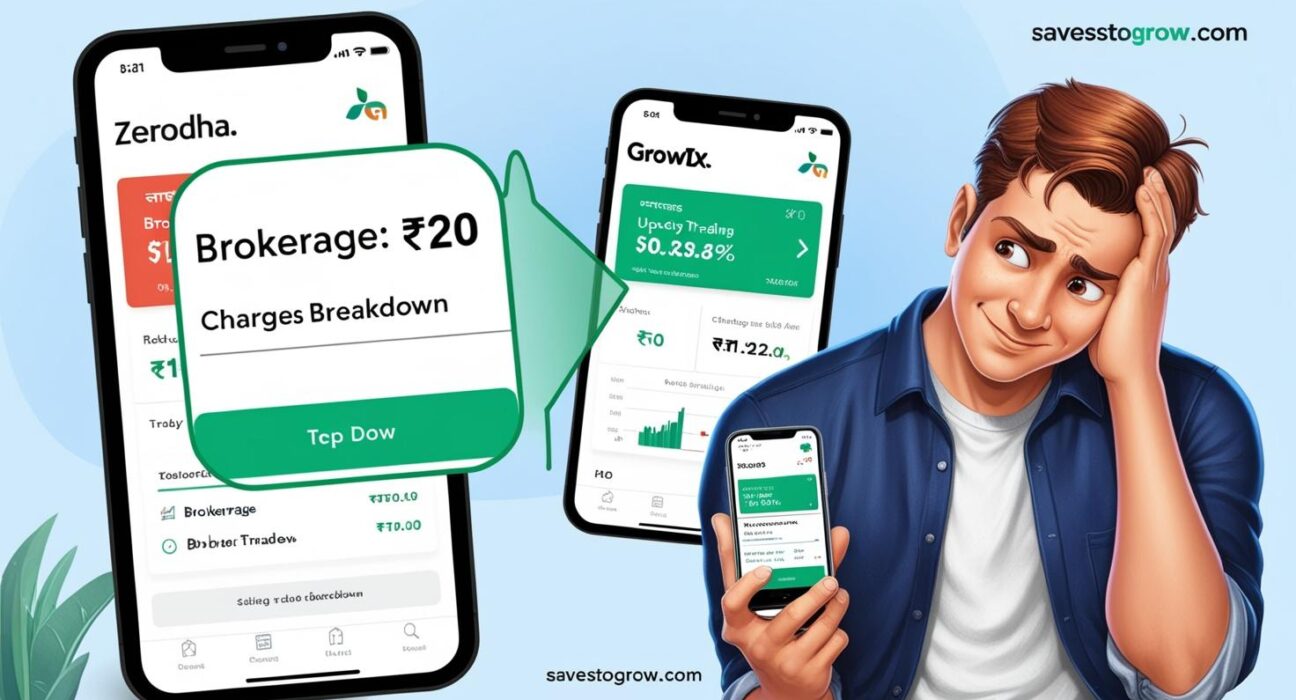
Introduction: The “Hidden Cost” of Trading
Imagine buying a movie ticket online—you pay ₹200 for the ticket, but the app adds a ₹20 convenience fee. That extra fee is like brokerage in stock trading.
Every time you buy or sell stocks, mutual funds, or ETFs, your broker charges a small fee. But how much? And can you reduce it? Let’s break it down.
What Is a Brokerage Charge?
Brokerage is the fee a broker charges for executing your buy/sell orders in the stock market.
Who Charges It?
- Stockbrokers (Zerodha, Upstox, ICICI Direct).
- Mutual Fund Platforms (Groww, Coin by Zerodha).
When Is It Charged?
✔ On buying stocks/ETFs.
✔ On selling stocks/ETFs.
❌ Not charged on mutual fund SIPs/Lumpsum (only expense ratio applies).
Types of Brokerage Charges in India
1. Equity Delivery (Long-Term Investing)
- Brokerage: Usually 0.1–0.5% of trade value or ₹20 per order (whichever is lower).
- Example: Buy ₹10,000 of Reliance shares → Pay ₹20 brokerage.
2. Intraday & F&O Trading
- Brokerage: Flat fee (₹20/order) or per-trade pricing (e.g., Zerodha: ₹20/executed order).
- Example: Day-trade 100 shares of Tata Motors → Pay ₹20 per trade.
3. Mutual Funds
- Direct Plans: Zero brokerage (only expense ratio).
- Regular Plans: Broker/distributor earns 1–1.5% commission (avoid these).
4. Demat Account Charges
- AMC (Annual Maintenance Charge): ₹300–1,000/year.
- Transaction Fees: ₹5–15 per debit (when selling stocks).
How to Calculate Brokerage?
Formula:
Brokerage = Trade Value × Brokerage Rate (or Flat Fee)
Example:
- Buy 10 shares of HDFC Bank at ₹1,500 each (Total = ₹15,000).
- Brokerage (0.1%) = ₹15,000 × 0.1% = ₹15 (or ₹20 if flat fee applies).
How to Reduce Brokerage Costs?
- Choose Discount Brokers (Zerodha, Upstox, Groww) → Lower fees than full-service brokers (ICICI Direct, HDFC Sec).
- Opt for “Direct” Mutual Funds → No commission.
- Use Limit Orders (Avoid market orders to control costs).
- Bundle Trades (Fewer orders = Fewer fees).
Full-Service vs. Discount Brokers
| Feature | Discount Broker | Full-Service Broker |
|---|---|---|
| Brokerage | Low (₹20/order) | High (0.1–0.5%) |
| Research | Limited | Extensive (reports, tips) |
| Best For | DIY investors | Beginners needing guidance |
Other Hidden Charges
✔ STT (Securities Transaction Tax): 0.1% on delivery trades.
✔ GST: 18% on brokerage.
✔ SEBI Turnover Fee: 0.0001% of trade value.
Final Takeaways
✔ Brokerage = Fee for buying/selling stocks (₹20–0.5% per trade).
✔ Discount brokers are cheaper than full-service brokers.
✔ Avoid regular mutual funds (they charge extra commissions).
✔ Bundle trades & use limit orders to save costs.

Prashant Thakur is the founder of SavesToGrow.com. He is not a financial advisor — he's a self-taught personal-finance enthusiast who learned to budget, save consistently, and invest from scratch, and now shares those hard-won lessons in plain, jargon-free English. Every guide is researched from primary sources such as the Income Tax Department, SEBI, RBI and AMFI, and reflects real, first-hand experience. Nothing on this site is professional financial advice — always do your own research or consult a SEBI-registered advisor before making money decisions.