Introduction: The “Hybrid” Investment
Imagine a mutual fund and a stock had a baby—that’s an ETF (Exchange-Traded Fund).
Like a mutual fund, it holds a basket of assets (stocks, bonds, gold).
Like a stock, it trades live on exchanges (NSE/BSE) at changing prices.
But how is it different from a regular mutual fund? And which one should you choose? Let’s break it down.
What Is an ETF?
An ETF (Exchange-Traded Fund) is a marketable security that tracks an index, sector, or asset and trades like a stock.
Key Features:
✔ Passive Investing – Most ETFs track indexes (e.g., Nifty 50 ETF).
✔ Trades on Stock Exchanges – Buy/sell anytime during market hours.
✔ Low Expense Ratio – Cheaper than most mutual funds.
Popular ETFs in India:
- Nippon India Nifty 50 ETF (Tracks Nifty 50)
- Gold Bees (Tracks gold prices)
- ICICI Pru Nasdaq 100 ETF (US tech stocks)
What Is a Mutual Fund?
A mutual fund pools money from investors to buy stocks, bonds, or other assets, managed by a professional.
Key Features:
✔ Active or Passive – Some beat the market, others track indexes.
✔ Bought via AMCs – Not traded on exchanges (except ETFs).
✔ SIP/Lump Sum – Flexible investment options.
Popular Mutual Funds:
- Axis Bluechip Fund (Active large-cap)
- UTI Nifty 50 Index Fund (Passive index fund)
ETFs vs. Mutual Funds: Key Differences
| Feature | ETF | Mutual Fund |
|---|---|---|
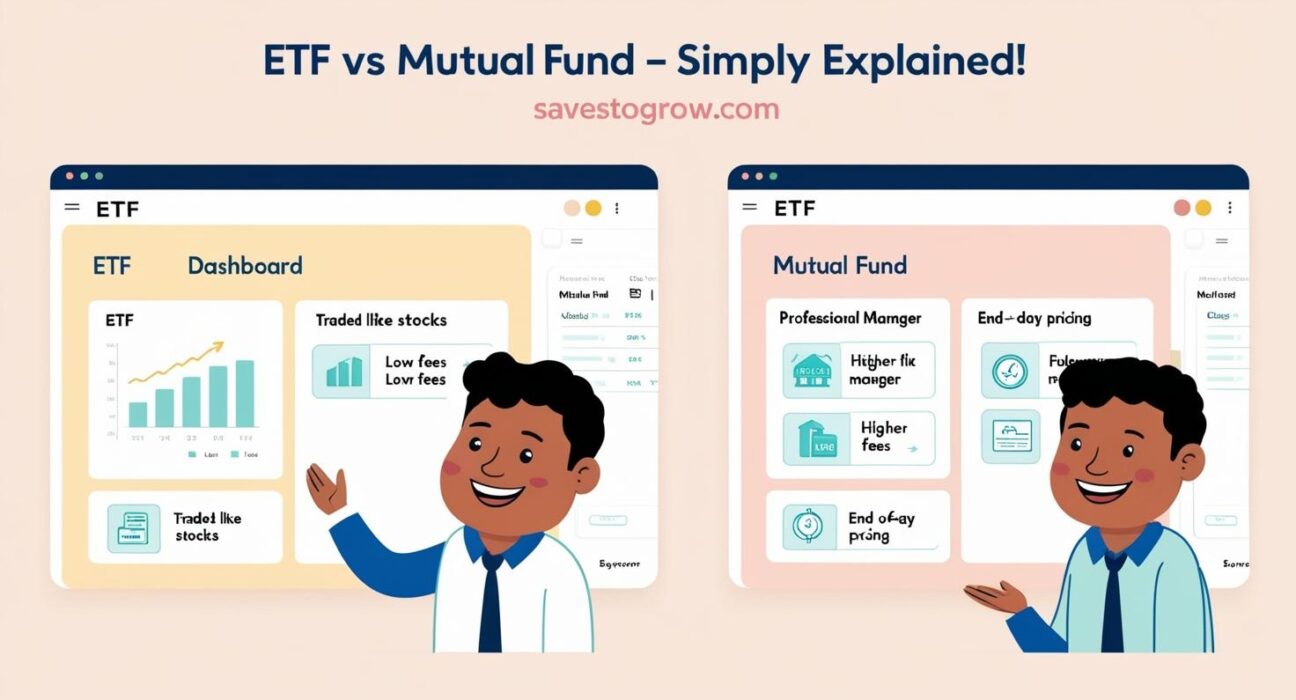
| Trading | Live on exchanges (like stocks) | Bought/sold at NAV (end-of-day price) |
| Expense Ratio | Very low (0.05–0.5%) | Higher (0.5–2% for active funds) |
| Liquidity | High (sell anytime) | Redeemable, but not instantly tradable |
| Minimum Investment | 1 share (e.g., ₹100) | Usually ₹500+ for SIPs |
| Best For | Traders + passive investors | Long-term SIP investors |
Pros & Cons of ETFs
✅ Pros:
- Lower fees than most mutual funds.
- More transparent (holdings visible daily).
- Intraday trading (buy/sell like stocks).
❌ Cons:
- Brokerage fees apply (per trade).
- No SIP automation (must manually buy shares).
Pros & Cons of Mutual Funds
✅ Pros:
- SIP option (auto-invest monthly).
- Wider variety (active, passive, sectoral).
❌ Cons:
- Higher fees (for active funds).
- Slower redemptions (T+2 days).
Which One Should You Choose?
Pick ETFs If You:
✔ Want low-cost, passive investing.
✔ Prefer trading flexibility (intraday buys).
Pick Mutual Funds If You:
✔ Want automated SIPs.
✔ Prefer active management (for higher returns).
Smart Strategy:
- Use ETFs for index investing (e.g., Nifty 50).
- Use active mutual funds for niche strategies (e.g., small-cap funds).
How to Invest in ETFs?
- Open a Demat Account (Zerodha, Groww).
- Search for ETFs (e.g., “Nifty Bees”).
- Buy/Sell like stocks (intraday or delivery).
Final Takeaways
✔ ETF = Index fund that trades like a stock.
✔ Mutual fund = Actively/passively managed pooled investment.
✔ ETFs are cheaper, mutual funds offer SIPs.
✔ Both can be great—choose based on your goals.

Prashant Thakur is the founder of SavesToGrow.com. He is not a financial advisor — he's a self-taught personal-finance enthusiast who learned to budget, save consistently, and invest from scratch, and now shares those hard-won lessons in plain, jargon-free English. Every guide is researched from primary sources such as the Income Tax Department, SEBI, RBI and AMFI, and reflects real, first-hand experience. Nothing on this site is professional financial advice — always do your own research or consult a SEBI-registered advisor before making money decisions.