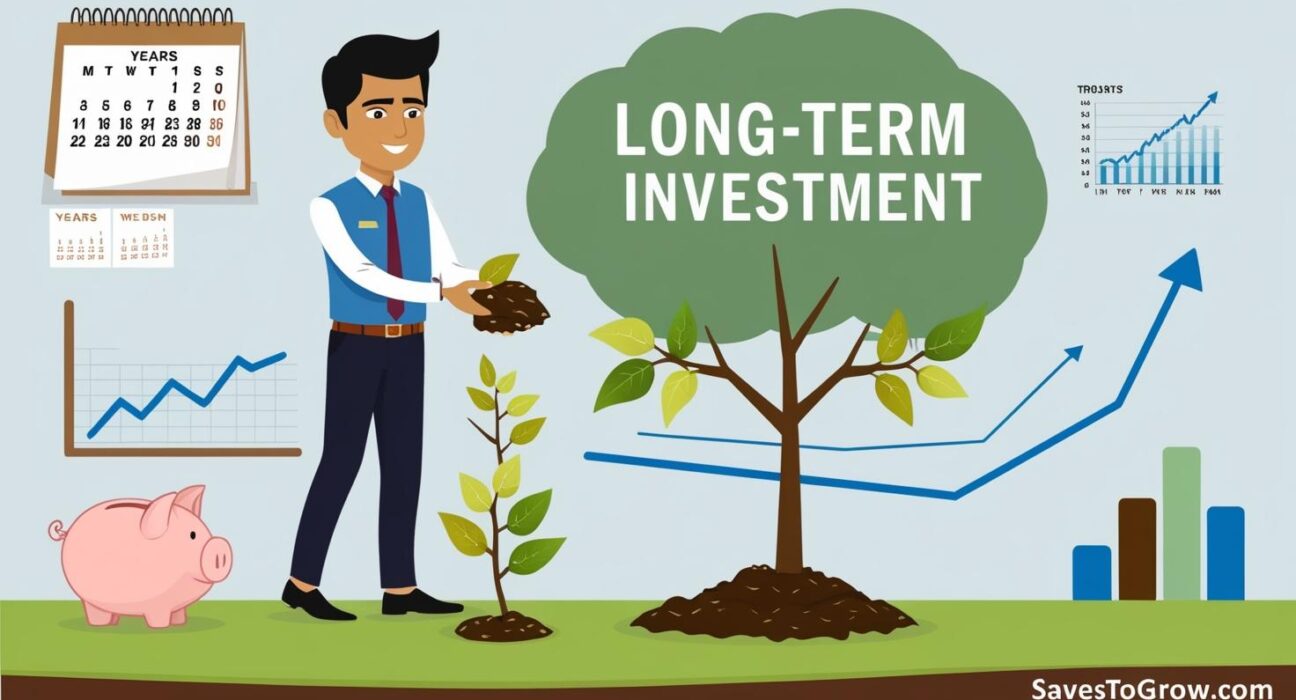
The tortoise wins the race
Picture two friends in 2004. Rahul invests ₹1 lakh in a Nifty 50 index fund and forgets about it. Priya trades in and out of the market, chasing tips and timing every dip. Twenty years later, Rahul’s ₹1 lakh has quietly grown to roughly ₹10 lakh — the Nifty 50 compounded at about 12–13% a year over that period. Priya, after all the fees, taxes, and stress, barely kept pace with a fixed deposit. That is the quiet power of long-term investing: letting your money grow like a tree instead of chasing quick wins.
What is long-term investing?
Long-term investing means buying quality assets — equity mutual funds, stocks, index funds, PPF, real estate — and holding them for 5 years or more (often 10–30 years), ignoring short-term market noise. The goal is wealth creation for big life goals: retirement, a child’s education, or a home. The approach is simple: buy good assets, keep investing regularly, and stay put.
Why long-term investing works
1. Compounding does the heavy lifting
Compounding means your returns start earning their own returns. It looks slow at first, then becomes astonishing. Here’s how a simple monthly SIP grows at an assumed 12% a year:
| Monthly SIP | Duration | You invest | Estimated value |
|---|---|---|---|
| ₹5,000 | 10 years | ₹6 lakh | ₹11.6 lakh |
| ₹5,000 | 20 years | ₹12 lakh | ₹50 lakh |
| ₹5,000 | 30 years | ₹18 lakh | ₹1.76 crore |
| ₹10,000 | 30 years | ₹36 lakh | ₹3.5 crore |
Notice how the last decade dwarfs the first — that’s compounding accelerating. Try your own numbers in our SIP calculator.
2. Time in the market beats timing the market
Nobody reliably predicts short-term market moves — a SEBI study famously found that the vast majority of individual intraday traders lose money. Long-term investors sidestep this game entirely and simply ride India’s economic growth. Staying invested through the ups and downs almost always beats jumping in and out.
3. Rupee-cost averaging smooths the ride
When you invest a fixed amount every month via a SIP, you automatically buy more units when prices are low and fewer when they’re high. Over years, this averages out your cost and removes the pressure of “buying at the right time”.
4. Lower stress, lower cost, lower tax
You don’t watch prices daily, you pay less in brokerage and fees, and — crucially — long-term gains are taxed far more gently than short-term ones (more on that below).
Long-term investing vs short-term trading
| Feature | Long-term investing | Short-term trading |
|---|---|---|
| Time frame | 5+ years | Days to months |
| Risk | Lower (volatility smooths out) | Very high |
| Effort | Minimal (passive) | High (constant monitoring) |
| Tax on equity gains | 12.5% LTCG (above ₹1.25L/yr) | 20% STCG |
The best long-term investments in India
- Equity mutual funds via SIP — the simplest engine of long-term wealth. Start from ₹500/month. See what a SIP is and how mutual funds work.
- Index funds — low-cost funds that track the Nifty 50; a superb hands-off core.
- Blue-chip stocks — large, stable companies held for decades. See what blue-chip stocks are.
- PPF & EPF — safe, tax-free compounding for the stable part of your portfolio (PPF calculator).
- NPS — retirement-focused, with an extra ₹50,000 tax deduction (NPS calculator).
- Gold & real estate — useful diversifiers, though less liquid.
Not sure how to split your money? Our guide to the best investment options for salaried people breaks it down by risk and goal.
How the tax works (FY 2026-27)
For listed shares and equity mutual funds held over one year, long-term capital gains above ₹1.25 lakh in a financial year are taxed at 12.5%. Sell within a year and short-term gains are taxed at 20%. Because the first ₹1.25 lakh of gains each year is tax-free, most small investors pay no LTCG at all — one more reason patience pays. Plan your overall liability with our tax regime calculator.
How to start long-term investing
- Define your goals — retirement, a child’s education, a house — and the years you have.
- Build an emergency fund first so you never have to sell investments in a crisis (how to build one).
- Open a demat & investment account and set up an automatic SIP.
- Invest regularly and step it up each year as your income grows.
- Hold and ignore the noise — don’t panic-sell in crashes; markets have always recovered.
Common mistakes to avoid
- Checking your portfolio daily — it only tempts impulsive decisions.
- Chasing hot tips — stick to your plan and quality assets.
- Selling in a crash — the 2008 and 2020 falls both fully recovered; panic-sellers locked in losses.
- Stopping your SIP when markets fall — that’s exactly when you buy units cheap.
Related guides
- What is a SIP?
- What is an index fund?
- What are blue-chip stocks?
- Best investment options for salaried people
Frequently asked questions
How many years counts as long-term investing?
Can I lose money in long-term investing?
How is long-term capital gains tax charged on stocks?
What is the best long-term investment for beginners?
How often should I review my long-term investments?

Prashant Thakur is the founder of SavesToGrow.com. He is not a financial advisor — he's a self-taught personal-finance enthusiast who learned to budget, save consistently, and invest from scratch, and now shares those hard-won lessons in plain, jargon-free English. Every guide is researched from primary sources such as the Income Tax Department, SEBI, RBI and AMFI, and reflects real, first-hand experience. Nothing on this site is professional financial advice — always do your own research or consult a SEBI-registered advisor before making money decisions.