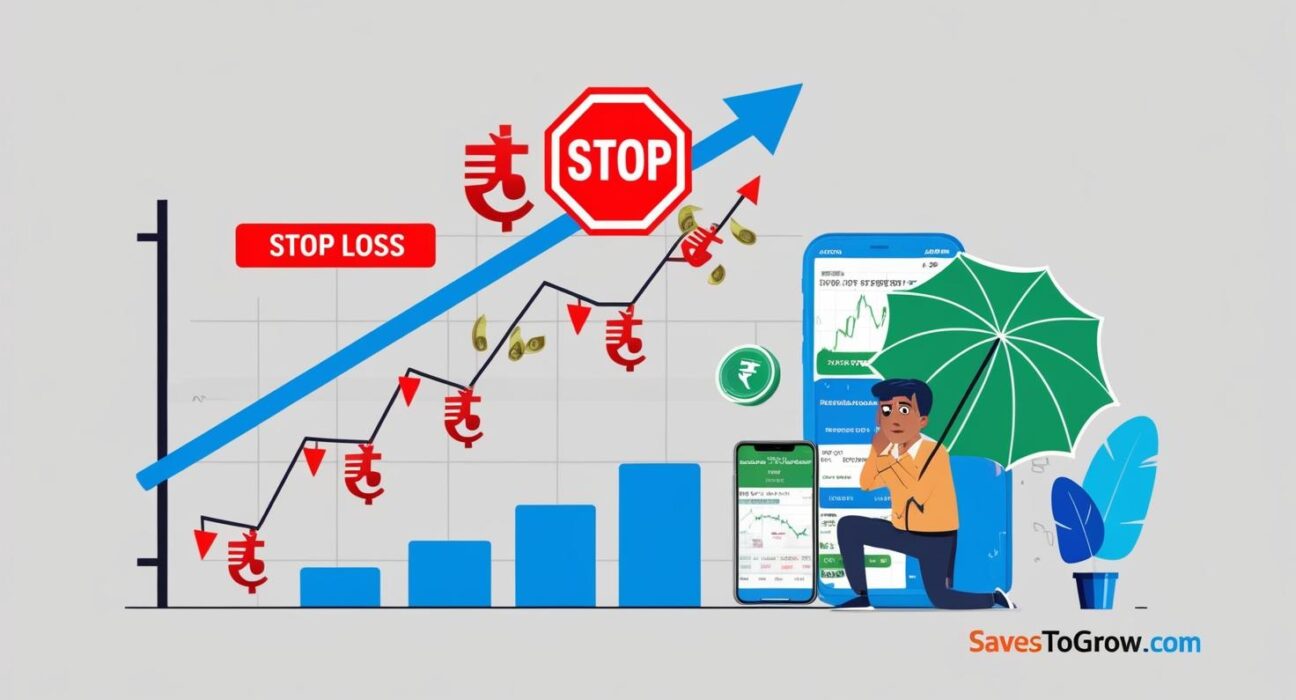
Introduction: The Trader’s “Safety Net”
Imagine you’re on a road trip. Your car has seatbelts and airbags—they don’t prevent accidents, but they protect you if one happens.
A stop loss does the same for traders. It’s an automatic exit order that limits your losses if a trade goes wrong.
But how does it work? And how do you set it correctly? Let’s break it down.
What Is a Stop Loss?
A stop loss (SL) is a pre-set order to sell a stock automatically if its price falls to a certain level.
Key Features:
✔ Automated Risk Control – No emotional decisions.
✔ Works in All Markets – Stocks, F&O, crypto.
✔ Customizable – Set your own risk tolerance.
Example:
- You buy HDFC Bank at ₹1,500.
- Set a stop loss at ₹1,450 (3.3% risk).
- If price hits ₹1,450 → Stock sells automatically → Loss capped at ₹50/share.
Why Use a Stop Loss?
1. Limits Losses
- Prevents a small loss from becoming a big disaster.
2. Removes Emotion
- No “hoping” for recovery while losses pile up.
3. Protects Profits
- Can be adjusted to lock in gains (trailing stop loss).
Real-Life Example:
- Yes Bank (2020) crashed 90%+. Traders without SL lost everything.
Types of Stop Loss Orders
1. Fixed Stop Loss
- Set at a specific price (e.g., 5% below buy price).
- Example: Buy at ₹100 → SL at ₹95.
2. Trailing Stop Loss
- Moves up as the stock rises (locks in profits).
- Example: Buy at ₹100, SL starts at ₹95.
- If stock rises to ₹110, SL moves to ₹105.
3. Percentage-Based Stop Loss
- Risk 1–3% of capital per trade.
- Example: ₹1 lakh portfolio → Max loss ₹3,000/trade.
How to Set a Stop Loss?
Step 1: Decide Your Risk
- Never risk more than 1–3% of capital per trade.
Step 2: Choose a Method
✔ Support Levels – Place SL below recent lows.
✔ Volatility-Based – Use ATR (Average True Range).
✔ Fixed % – E.g., 5% below buy price.
Step 3: Place the Order
- In Zerodha/Upstox: Select “Stop Loss” while buying.
- For Existing Holdings: Add SL via “Create Rule.”
Common Stop Loss Mistakes
❌ Setting SL Too Close – Gets hit by normal volatility.
❌ Ignoring SL – “It’ll recover” mindset → Bigger losses.
❌ No SL in F&O – Leverage magnifies risks.
Stop Loss vs. Target
| Order | Purpose | Example |
|---|---|---|
| Stop Loss | Limit losses | Sell if price ≤ ₹95 |
| Target | Book profits | Sell if price ≥ ₹120 |
Smart Traders Use Both!
Final Takeaways
✔ Stop loss = Automatic exit to limit losses.
✔ Use fixed, trailing, or %-based SL based on your strategy.
✔ Never trade without SL—it’s your financial seatbelt.
✔ Risk only 1–3% per trade.

Prashant Thakur is the founder of SavesToGrow.com. He is not a financial advisor — he's a self-taught personal-finance enthusiast who learned to budget, save consistently, and invest from scratch, and now shares those hard-won lessons in plain, jargon-free English. Every guide is researched from primary sources such as the Income Tax Department, SEBI, RBI and AMFI, and reflects real, first-hand experience. Nothing on this site is professional financial advice — always do your own research or consult a SEBI-registered advisor before making money decisions.